A shared language for water.

The Virtual Irrigation Academy began as a research project at CSIRO, funded by ACIAR, the Australian Centre for International Agricultural Research. It is now an independent Australian not-for-profit organisation.

The idea behind it is simple. Farmers know a great deal about their own land that never gets written down, and scientists produce research outputs that farmers cannot use. A colour that both can read turns those two things into one conversation. That is what the name means, and it is the part worth holding onto — VIA is an Academy, a learning system. Yes, we built a sensor-making factory too.

100,000+ sensors later, that shared language has built a record of on-farm water use spanning a decade and 20+ countries.

For a deep dive into water, soil and how the colours work, take the Water School — VIA’s free online course.

VIA around the world

The same three colours are being read this morning in 20+ countries. These are the places where somebody measured what changed.
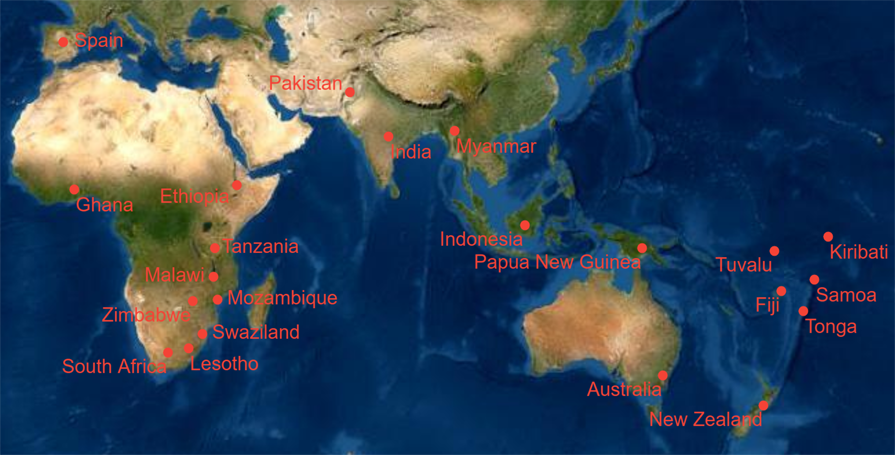
Map of the countries where VIA has worked
Ghana
+35% water efficiency
16% of irrigation water saved.
Upper East Region pilot
Ethiopia
Improved yields
Water efficiency gains across three sites.
Evaluation in Lemo, Dangila and Mecha
India
8–52% water saved
+17% yield on non-paddy crops.
IWMI RESILIENCE project
Pakistan
20–30% less irrigation
With increased productivity.
IWMI–VIA initiative

A scientist’s story

Richard Stirzaker is a soil scientist who spent thirty years asking why irrigation advice so rarely survives contact with an actual farm, particularly for the 90% of farmers who cannot reach the technology. The Chameleon came out of his own back garden in suburban Canberra, and went through decades of formal research. But the garden is still the place where he tests new things.

“There are few more fundamental issues facing humanity than how best to feed ourselves in an increasingly crowded world, and — in Australia especially — what that means for scarce water resources.”

“Richard Stirzaker draws upon deep, hard-won knowledge of his own garden and his family’s experiences in that garden — as laboratory, workshop, study, pantry, playground and place for reflection.”

— Andrew Campbell, Chief Executive Officer of the Australian Centre for International Agricultural Research (ACIAR) 2016–2023, reviewing Out of the Scientist’s Garden

Timeline

  1. 2014
    ACIAR funds the Virtual Irrigation Academy project with CSIRO.
  2. 2015
    First three Malawi schemes receive Chameleon sensors.
  3. 2016
    Sensor production line set up in Pretoria, South Africa.
  4. 2018
    More than a thousand monitoring sites in Malawi alone.
  5. 2020
    First publications documenting increased yields with less water.
  6. 2022
    MoU with the Malawian Ministry of Agriculture and a local company.
  7. 2023
    Water Changemaker Award at COP28, and Top Innovator in the World Economic Forum Smarter Climate Farmers Challenge.
  8. 2026
    100,000+ sensors manufactured, deployed across 20+ countries.

Media

  • Australia’s Foreign Affairs Minister highlighted VIA at the UN General Assembly, September 2023.
  • Featured in “40 years of ACIAR”, July 2023.

“The Chameleon soil water sensor is one of the most novel and transformative pieces of technology to arise from ACIAR-supported research.”

— 40 Years of ACIAR, p102

Making the sensors

Who we have worked with

Also withMalawi Department of Agricultural Research Services · Malawi Department of Irrigation · Mechro Limited · World Economic Forum UpLink